Across the Yorkshire Dales to York.
We had a very nice day, winding up in York for the afternoon and evening, our final night before returning to London tomorrow.

We left Kirkwood House around 9:15, and headed in Bowness, as I wanted to see if I could pick up a Beatrix Potter t-shirt for Noah from the Beatrix Potter children’s museum, but although they all things Peter Rabbit, they didn’t carry t-shirts. I was also going to try the Beatrix Potter Hill Top cottage in Near Sawrey (that’s the name of the village, Near Sawrey), just across the lake from Bowness, near Ambleside where we were yesterday, where Beatrix lived and wrote and illustrated many of her children’s books. But, it was out of the way and we wanted to get to York so we could spend some time there, and had some other stops we wanted to make on the way.

So, we hit the road, heading for York, about 130 miles and four hours from the Lake District, first heading east almost half the way across England (which is a small country) and then south, with stops along the way as we left the Lake District and entered the Yorkshire Dales. It was a great drive, traveling through excellent and classical British scenery almost the way, and driving some narrow back country roads that were essentially single lanes, in some cases with no pullover spaces at all, so if a vehicle was was coming the other way someone was going to have to reverse and find a pullover space to let the other vehicle through.


These are actually beautiful country lanes (even through they are actually designated as B roads) lined by hedgerow or thick vegetation, but nerve wracking to drive. There were several that Google Maps took me to that I simply refused to take, waiting instead for the map to re-route me. As lovely as these narrow roads are, passing through the most countryside of countryside scenery, I was happy to be done with them. I would’ve taken some photos to show just how narrow they are, but there’s simply no way to stop, except in the middle of the lane, but I dared not.


We passed through several villages along these small roads, and even the A roads were pretty narrow in many cases, stopping for some photos were we could, and enjoying the very green and lovely hills and dales as we passed from Cumbria and the Lake District into the Yorkshire Dales, although I really couldn’t tell the difference between these two beautiful landscape types. We made our first stop in Hawes, a small market town about 45 miles east of Windermere, in the heart of the Yorkshire Dales National Park, surrounded by traditional Dales landscapes and a beautiful stone built town. The changes here, in comparison with Lake DIstrict villages, were clearer, with more stone buildings and walls dotting the village and surrounding area. all built with local stone.


This entire region is ancient. Like all the villages and towns in the region, Hawes is old, very old, dating back at least 1200 years when it was a Viking settlement during the 9th to 11th centuries, and its name is probably of Old Norse origin. The village appears in the Domesday Book of 1086, soon after the Norman conquest of 1066, so was certainly well settled by then, and it received a market charter in 1307. Most of the the stone buildings in the village are much newer though, mostly from the 18th and 19th century. It’s a beautiful place to visit.
We continued on, and passed through a few more small towns and villages, but not stopping as we wanted to get to York with enough time to visit, as we’re there for just one night. But, given our route, we continued along those insanely narrow country lanes, and wider, but still not wide by any standards, A roads. At one point we had a frightening moment as we rounded a curve in the road to see a car in our lane, as it was passing a row of 6 or 7 cars on the blind curve, heading directly for us, pulling in with just a few seconds to spare. Another 30 feet, or had we been moving a little faster, or 10-15 seconds later, there would have been a head on collision. Insanity.
I wonder why they don’t widen the roads, as there’s ample room to do so on most of the roads, usually with countryside on either side, although it may be more complex than I imagine (and especially where there’s dense hedgerow), or perhaps they want to retain the flavor of this part of the country.
At any rate, we arrived in York around 2, and checked into our hotel, which was once again in a great location, literally a few minutes walk from the walled part of the city, which was the reason we visited York. The hotel itself was, well, functional. Nicely enough maintained, but nevertheless very basic, with virtually no amenities, and not even a small desk in the room. Still, it worked for us, and we were exactly where we wanted to be.


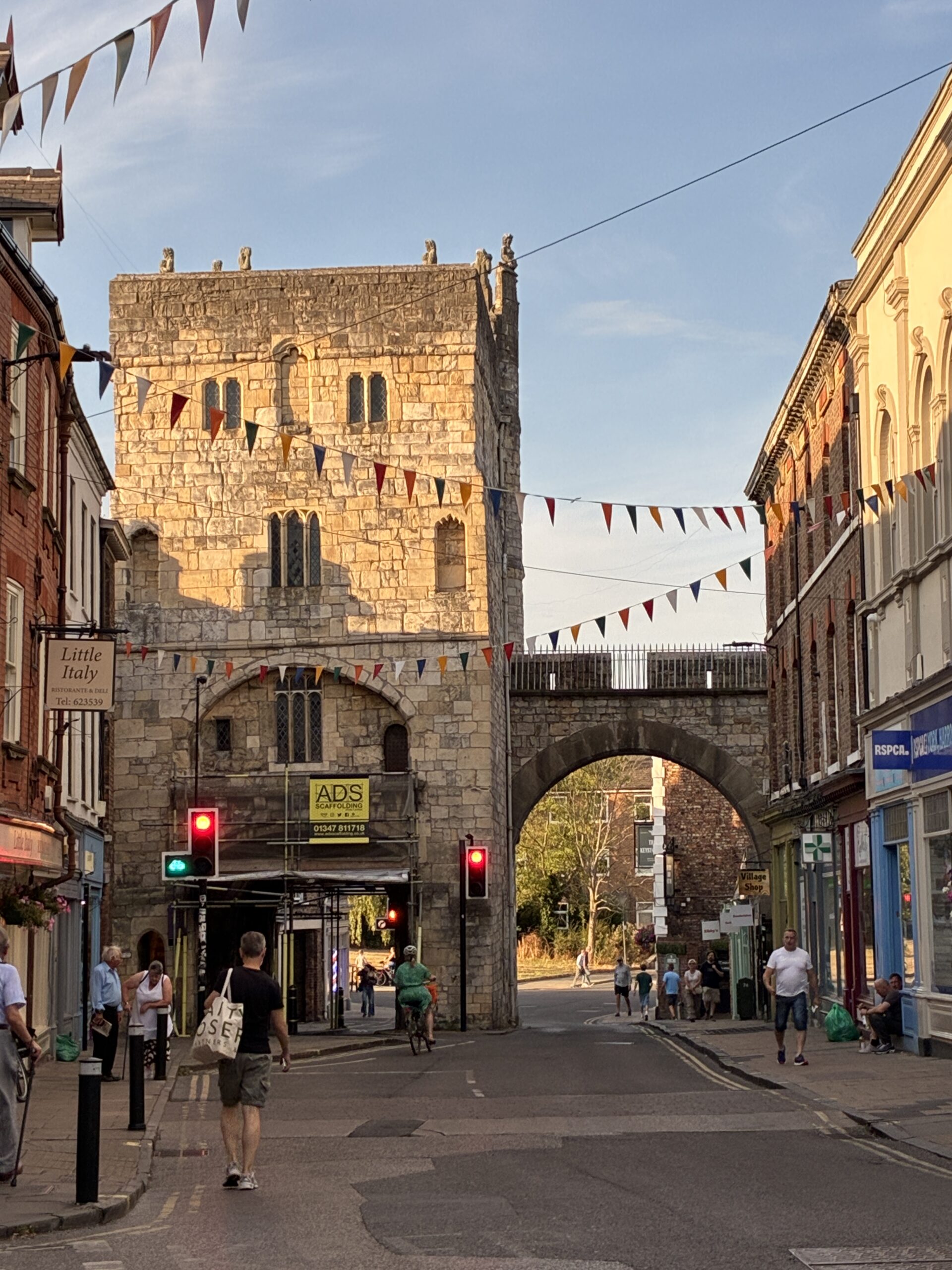
And then, to the city, beginning with a walk atop the walls that surround the ancient town of York, easily accessible by stone steps leading up from each of the gates, or bars, to the city. Our hotel was on Monkgate, minutes away from Monk Bar, the first gate we entered.

Monk Bar (as in gate or barrier) was built in the early 1300s, and expanded in 1484. It’s pretty old, but the town is far older than that. Like London, York was originally a Roman town founded in 71 ACe, then named Eboracum. There is a statue in front of York Minster Cathedral of Constantine the Great, the Emperor of York in 306 ACE.

After the Romans withdrew in the early 5th century, York became part of the emerging Anglo-Saxon kingdoms, and known as Eoforwic, the capital of the kingdom of Northumbria. Three centuries later, in 866, the Vikings captured York, naming it Jórvík, and it became one of the most important Viking settlements in Britain. The city was still enormously important when William the First invaded England in 1066 and soon after built two major castles here, around the same time as the Tower of London was built, with Clifford’s Tower, the remains of one of the castles, still standing. By the 12th–14th centuries, York was one of England’s largest and most prosperous cities… and the rest is history.

One of the dark episodes in York’s history was the massacre of the city’s Jewish community in 1190. England was a hotbed of anti-semitism, and one hundred years later, in 1290, all Jews in England were expelled from the country by order of Edward I, ending a Jewish presence in England dating back about 200 years, beginning soon after the Norman Conquest, returning to England almost 370 years later in the 1650s.
We walked the walls of the city, covering about two miles and largely built between 1250 and 1350, although there were many later alterations and additions. They no longer go all the way around the city as they once did, but there are still large stretches that are great to walk. I’ve been to York three or four times, but never previously walked the walks, although I can’t imagine why not.


Walking the walls was actually a great way to see the city, not only from slightly above but also in seeing different parts of city contained within the perimeter of the once defensive walls.


A major highlight of the walk along the city walls was seeing York Minster Cathedral come into view. Officially the Cathedral and Metropolitical Church of Saint Peter in York, the cathedral is the seat of the Archbishop of York, one of the two most important Anglican cathedrals in England (the other is Canterbury Cathedral), and is the largest medieval Gothic cathedral in Northern Europe. The name Minster dates back to Anglo-Saxon times, describing a church that also had a missionary and teaching role, and was a mother church, and the title is a link to the cathedral’s ancient roots.


There were several churches on the site before the cathedral, and King Edwin of Northumbria was baptized here in 627 ACE, and after the Norman conquest a large Norman cathedral was built here around 1080. Construction of the present cathedral began around 1220 and was completed by 1472.


Walking the wall we came to the River Ouse, which flows through the city, and came down to street level, where Tom enjoyed a pint in a small outside garden on the river and I had a lemonade, both of us enjoying the warm (hot) weather and the scenery. Just lovely.


We walked through the streets, heading toward to Cathedral area, but a primary goal was getting to the Shambles, a street happily spared from city modernization, and York’s most famous medieval street, and one of the best-preserved medieval shopping streets in Europe, its current form dating back to the 1400s, but existing long before that, and is listed in the Domesday Book of 1086, which was a record of wealth, landholdings, and resources across England and Wales. The street name comes from the medieval word “shamel,” meaning a bench or stall where meat was sold, as the street was historically occupied by butchers’ shops.
The whole area, close to Monk Bar and near the Cathedral, as you enter the walled city, Is really lovely, with great little streets and stores, but the Shambles is the heart of the area and the most preserved.


The entire area surrounding the Shambles is lovely, of course, and we enjoyed walking the narrow streets and squares, with medial and newer streets and buildings side by side.


While walking the streets, Tom recalled there as a partial eclipse of the sun today, visible between 7-8, just as we saw a crowd gathering to view it through filtered glasses. A guy on the street kindly loaned us his eclipse glasses, and the sight was pretty amazing. I couldn’t take a photo of course, but it pretty much looked like this when viewed through the glasses, a glowing crescent against a black orb as the moon slipped between the Earth and the sun. It actually looked more amazing than this photo, with the black orb clearly defined .

Through the camera, I couldn’t see the eclipse at all (no bare eye viewing, of course), but it was still a nice photo.

Still wanting to eat traditional food, we ate cottage pie at a well preserved old pub in the center of the walled town, although Tom never got to eat Yorkshire Pudding, and we walked around the walls a little more as the sun was setting, before heading back to our room and eventually hitting the sack. Hot as it was in that room, it was impossible to keep the window open as the sound of cars along the main street below kept waking me up, but we happily had a floor fan, which helped cool the room overnight.
Tomorrow we head back to London, stopping in Cambridge for a quick visit along the way, but we have to be back early enough to return the car to the Kings Cross area by 5:30 pm.

