Devon and Cornwall: Clovelly and Tintagel.
We slept well at the Park Hotel, which is a very nice place, and set out around 10 for Clovelly, a small village in Devon on the upper southwest coast, sitting on the Barnstaple Bay, just below the Bristol Channel. I was here with Bev, Kaye, and Hilary in 1991, but had little strong memory of the place, other than it was lovely. And steep. And quaint. All of which it is.

Clovelly is a small village built on a cliff overlooking the bay, with very steep cobblestone streets leading down to the harbor. No cars are allowed in the village, although there is a service road, and it is possible for people to hire a vehicle to take them back up from the harbor. When I last here, you can hire a donkey to bring you up (I think). The village is old, appearing in the Domesday Book of 1086 (a detailed land and property survey of England, commissioned by William the Conqueror in 1085). The village was later passed from the monarchy to a private family in 1242, and it has been privately owned since, and owned by descendants of the same family since 1738, who still own it today.
It may be the only village in England that charges an admission fee, at the visitor center through which you enter the village.

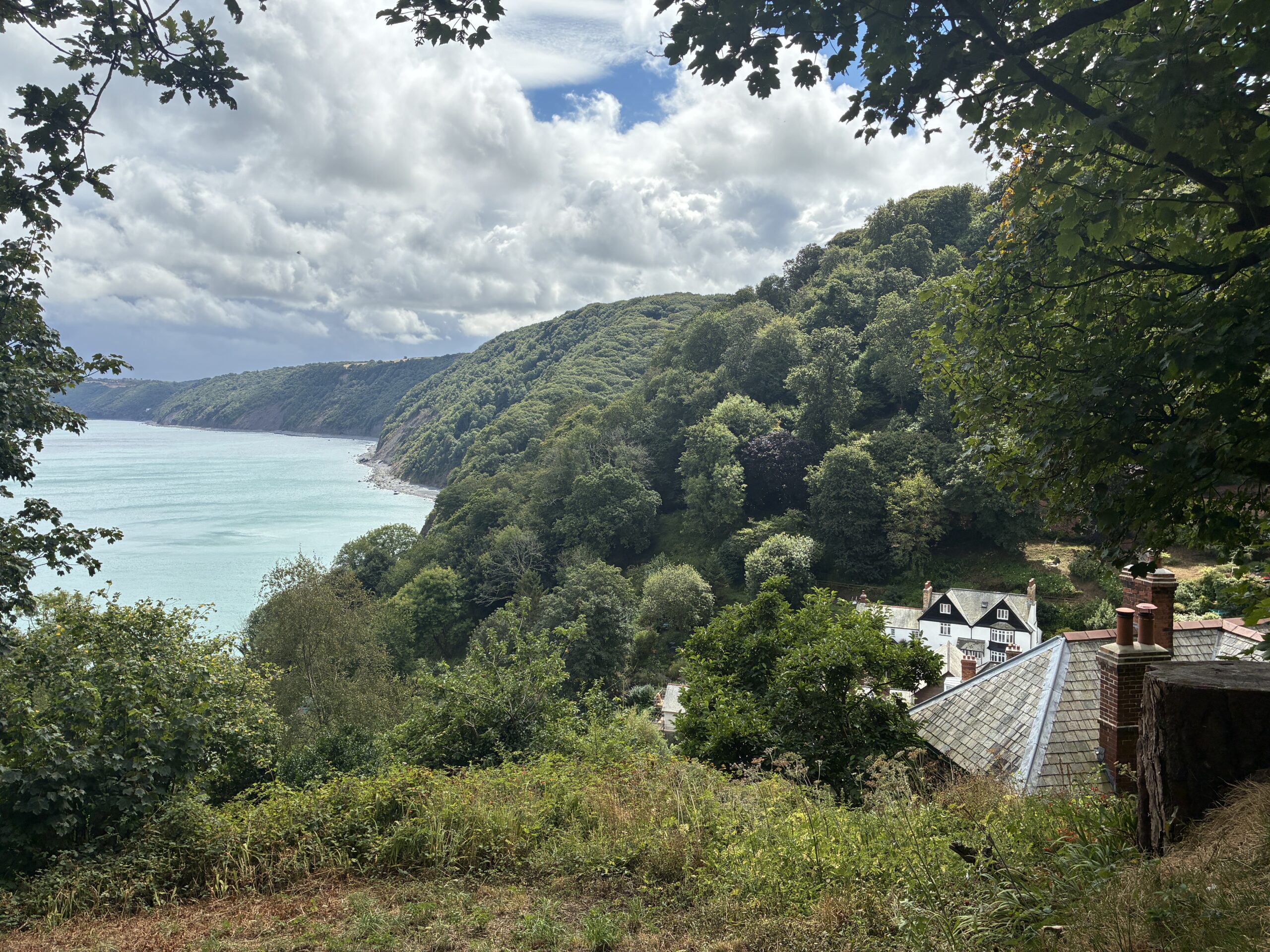


It is steep, and the cobblestone streets winds down to the water, past stores and small and very picturesque cottages all the way down. No doubt about it, it is a tourist town, and that’s how it makes its money, but a lovely tourist town not to be missed, and emblematic of this part of the country. It is really a world class attraction.


We spent a couple of hours or so in the village, before taking what seemed the long trek back up those cobblestoned hills, and then drove on to Hartland Quay, along the west coast and the South West Coast Path that stretches 630 miles along the west coast, around the southern peninsular of England, and up the south east coast to Poole, on the southern coast. It is also known as the Salt Path, from the book by that name. It’s rugged at times, and that includes the path along the cliffs overlooking Hartland Quay and the Bristol Channel and Atlantic below.
We walked the rugged trail for about 2 miles until reaching Speke’s Mill Mouth, and enjoyed every second of the walk and the great views of the cliffs and the sea below, as well as the hills that surrounded us. The weather was great.


We were sort of deciding where to go next as the day moved on, father than having a set agenda, and we decided at this point to head down to the fabulous Tintagel in Cornwall, a village I’ve visited at least four times previously, on my own and with various friends, including Bev, Hilary, and Kaye.
By now, I can’t say I was driving perfectly in our right hand drive SUV, but I was doing pretty well, and recalled these narrow, and sometimes very narrow roads in the West Country of Devon and Cornwall. Many of these smaller roads are essentially single lane, and always require one vehicle to pull over into the hedgerows to let the other through, and sometimes even reversing to let the other vehicle pass as there’s not always a place to pull into. I sort of enjoy the driving, but it is sometimes white knuckle on these narrow roads.

We drove an additional hour south to the village of Tintagel , which is just 34 mile away but takes over an hour, passing from Devon into Cornwall, along the southwest coast (and along the coastal trail, if you;re walking). Well, not quite! It was time to get gas – but in this part of the country, it runs out, petrol stations are few and far between, and the one station we stopped at had no gas! It took a fair amount of driving back and forth, on those narrow back and side roads before we found one, after first reaching an abandoned gas station. We were not on the edge of running out of gas, but not sure just how far out of our way we’d have to go to find a petrol station, and whether or not it still made sense to go to Tintagel. We made it, of course – and it cost $84 to fill up! Yikes.
As a result, we got to the small village of Tintagel around 5 pm, and of course much was closed, including tickets to Tintagel Castle, and my very favorite Cornish Pasty bakery. The village is very lovely, although simpler and less picture book perfect than Clovelly, with a history spanning over 1,500 years, from a post-Roman royal stronghold and trading hub into a medieval fortress, intertwined with Arthurian legend. Tintagel Castle is built on a narrow headland connected to the mainland by a footbridge, and although now ruins, but dramatic ruins, was built around 1230 by the Earl of Cornwall, who was the brother of King Henry III. Although not included in the Domesday Book, it is of that era, and the Tintagel Old Post Office was built around 1380, and St Materiana’s Church of Tintagel, which is still a working church that we visited, was built between 1080–1150.


Even though the ticket office for for the castle was closed, and the bridge leading to the main castle was gated (I’ve been several timers before, most recently in 2017, with Bev, Matrilyn, Alan, Harold, and Suzanne), we were nevertheless able to take the footpath to the castle, and visit some of the ruins on the surrounding hill, and from there step onto and walk some of the coastal trail, visiting St Materiana’s Church along the way.
The pathway down to the castle trail is steep – especially coming back up, and I well remember walking back up with 4-yr-old Kaye on my shoulders struggling with that uphill walk, even back then when I was 35 years younger than I am now.


As we headed back into town after enjoying the walk and the scenery, it started to rain, as it has on a number of the occasions I’ve been here. It didn’t last long, but it adds to the ambiance! And then, as we reached the top of the footpath leading back to the village, it was finally time for a traditional home made, hand cooked, fresh from the oven Cornish Pasty. The best ones I’ve ever had come from right here in Tintagel, although my favorite pasty bakery (and Alan’s) was closed, although I think it’s the ambiance here that makes them taste so damn good.
Never mind, we got fresh pasties from a bakery just across the road, and they were good.


And then, our stomachs filled – and Tom is certainly getting some of the tastes of England – we headed back to the Park Hotel in Barnstaple, and, soon after to bed, after another long day of sightseeing and walking. Tomorrow we head to Bristol, where we’ll be staying two nights. and from where we’ll be visiting the city of Bath and surrounding areas and rolling hills of the Cotswolds and dramatic landscapes of the Mendip Hills in Somerset. Till then, goodnight.