The Streets of Oaxaca.
After Rachel returned from her early morning gym class, I learned about the garbage collection. The truck comes around sometime in the early morning, at no set time and in no set location, but ringing a bell so that the locals know it’s somewhere in the vicinity, if not exactly where. Then you get out there with your garbage, locate the truck, and empty your garbage into it. The truck comes several times a week, with some days for organic and some for non-organic. It works for the locals though, but you have to be on your toes and alert for the sound of the ringing bell.
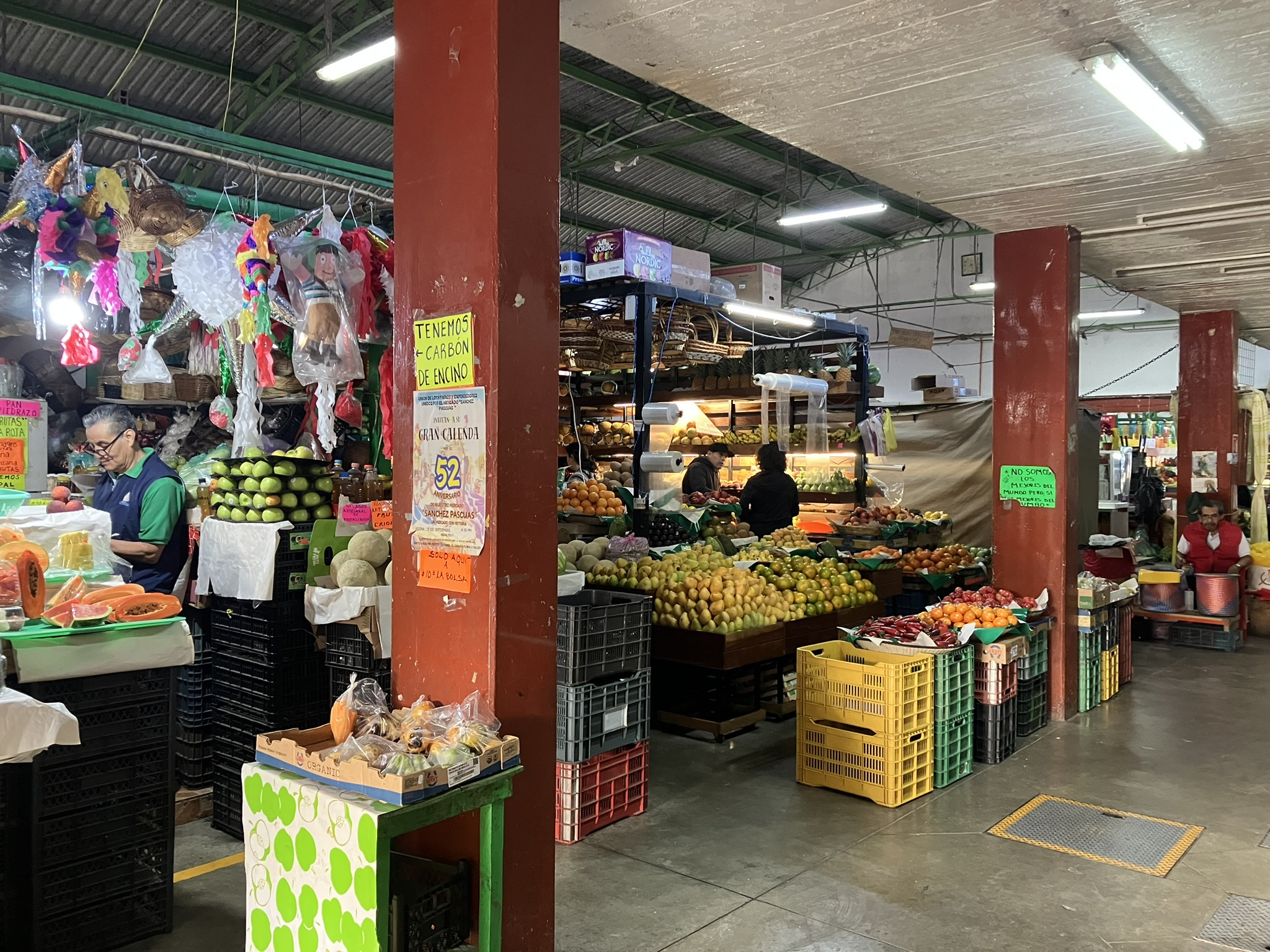
Then we headed to a local central market where Rachel needed to pick up some fruits, vegetables, and meat. I again really enjoyed walking the streets, and taking photos that I hope capture a little of the feel.


The central market local to Rachel in the Xochimilco district, which is the oldest barrio in Oaxaca, a splendid place, a smaller version of a smaller version of the November 20 market in the central part of the Oaxaca, and the Boqueria indoor market in Barcelona, filled with sellers of produce, nuts, meats, and all sorts of other things, local and colorful.
Prices here are a little more than in other markets a little further into the city, perhaps because of the number of ex-pats living in this district, and some prices were not so different than prices in the U.S., but on the whole, it’s certainly less expensive as you’d imagine. It was odd, though, to see fruits on some stands marked with exactly the same labels and codes as they are in my local Stop and Shop.


On our back home, Rachel got a couple of tamales, which made for a pretty tasty breakfast, and especially the tamale cooked with mole, which really added a level of deliciousness. Mole (pronounced mohlay, with an accent on the é) is a traditional Mexican sauce made with spices, chili peppers, and chocolate, and Oaxaca is known for its mole. It’s often added to enchiladas, burritos, chicken and meat dishes, and soups and stews. It’s delicious.
One of my, and Bev’s, favorite singers, Lila Downs, a well-known Mexican singer, lives here in Oaxaca, and has a truly wonderful song about the making of mole, La Cumbia El Mole. The song begins, “They say in Oaxaca you drink coffee with mezcal… I like to try the mole that Soledad is goin’ to grind.”


Rachel headed off to her Spanish class, and I worked on this journal, and read a little until she got back, after which we headed to the downtown Linea Unidas bus station, where I bought my ticket to Mazunte, which I’ll head for tomorrow to visit Anna and Lance.
The bus station was just what I expected, and I’ve seen many like this, both across Europe and during my travels in Mexico, many years ago, but still vivid in my memory, when I frequently traveled by local buses. I very clearly recall being in a bus station like this, although a little larger, back then, around 1981, drawing the old and beat up school buses that had been converted for public transport. with a crowd of local men around me, watching.

These buses today, and many were large transport vans rather than full-size buses, were just coming and going, reversing in and out of spaces, seemingly completely oblivious to whether anybody was standing behind them or not. You had to be on guard, for your own safety, as the bus drivers certainly weren’t looking out for your health and safety. It was bustling and noisy. I loved it.

The inscription reads, “The local! Villa Hermosa. And what a crowd. Buses roaring, horns tooting, whistles blowing, music playing, people yelling.” Just like today in the Oaxaca bus station.
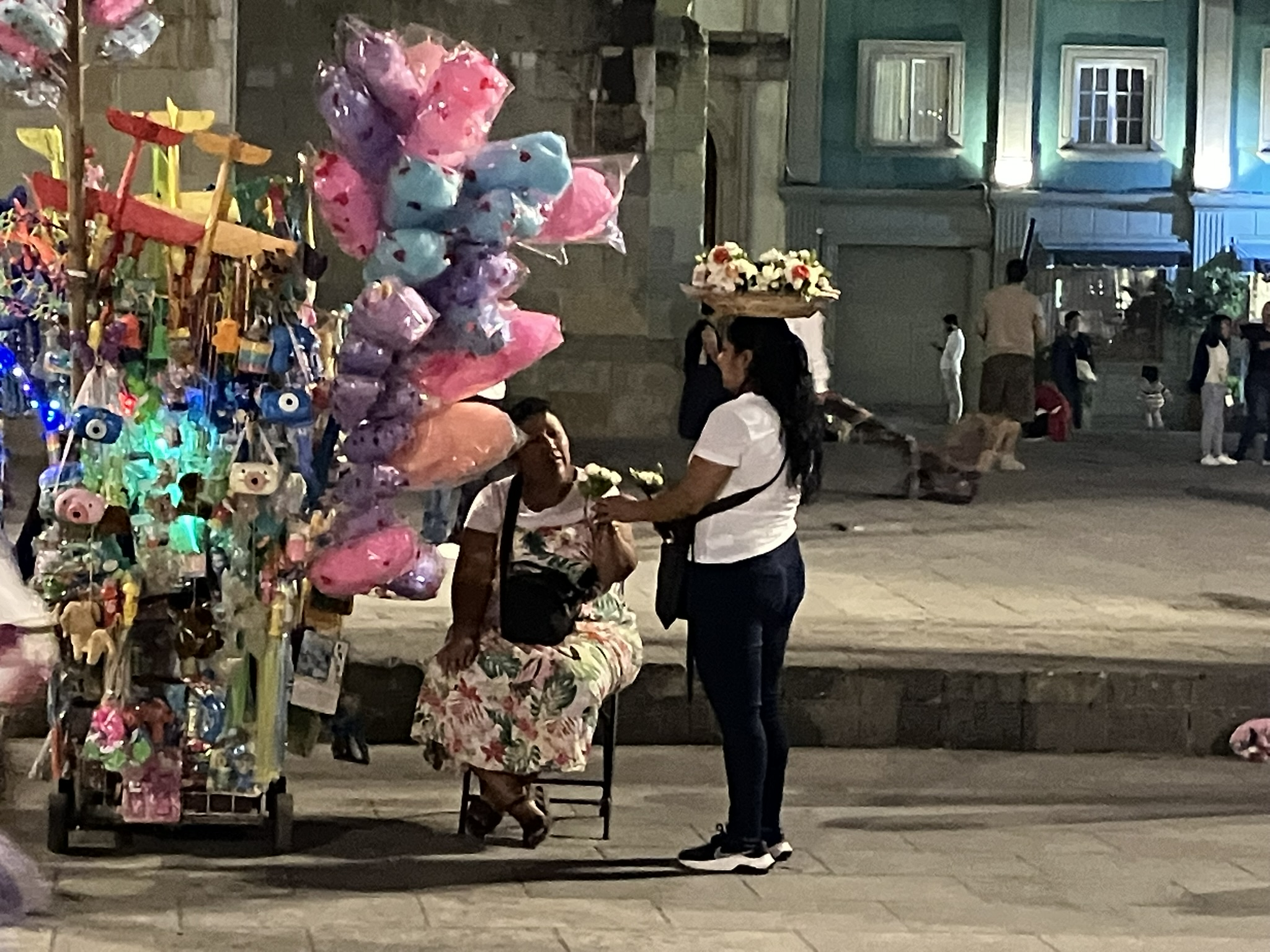
After getting my ticket, although we took a taxi to the bus station, we walked back. It’s only about 1½ miles, and a great walk through these very bustling Oaxacan streets, loaded with street vendors, and lined with stores, eateries, bars, and small galleries, and the lovely Mexican architecture, with small parks, large squares, and churches along the way.
Traffic in the street was not really much better than the bus station, with drivers who did not seem to be too concerned about pedestrians, and in most cases did not give way to pedestrians. Nevertheless, people clearly know how to drive the streets and follow the rules, although those rules aren’t obvious to an outsider. There are very few traffic lights, and no stop signs or yield signs. You just have to know the rules. Also, as you would expect, lots of scooters and small motorcycles zipping along the streets, which, for the most part cobblestone rather than being black topped or paved. The sidewalks are narrow, and filled with people.


People are friendly and the streets are pretty clean. And visible everywhere are the multicultural roots of the region, in which the state and city of Oaxaca are multicultural, retaining their roots in indigenous culture. A number of stores sell particular goods from towns known for the product that’s being sold, such as Teotitlan, about twenty minutes outside of the city, known for rug-making since pre-Hispanic times.
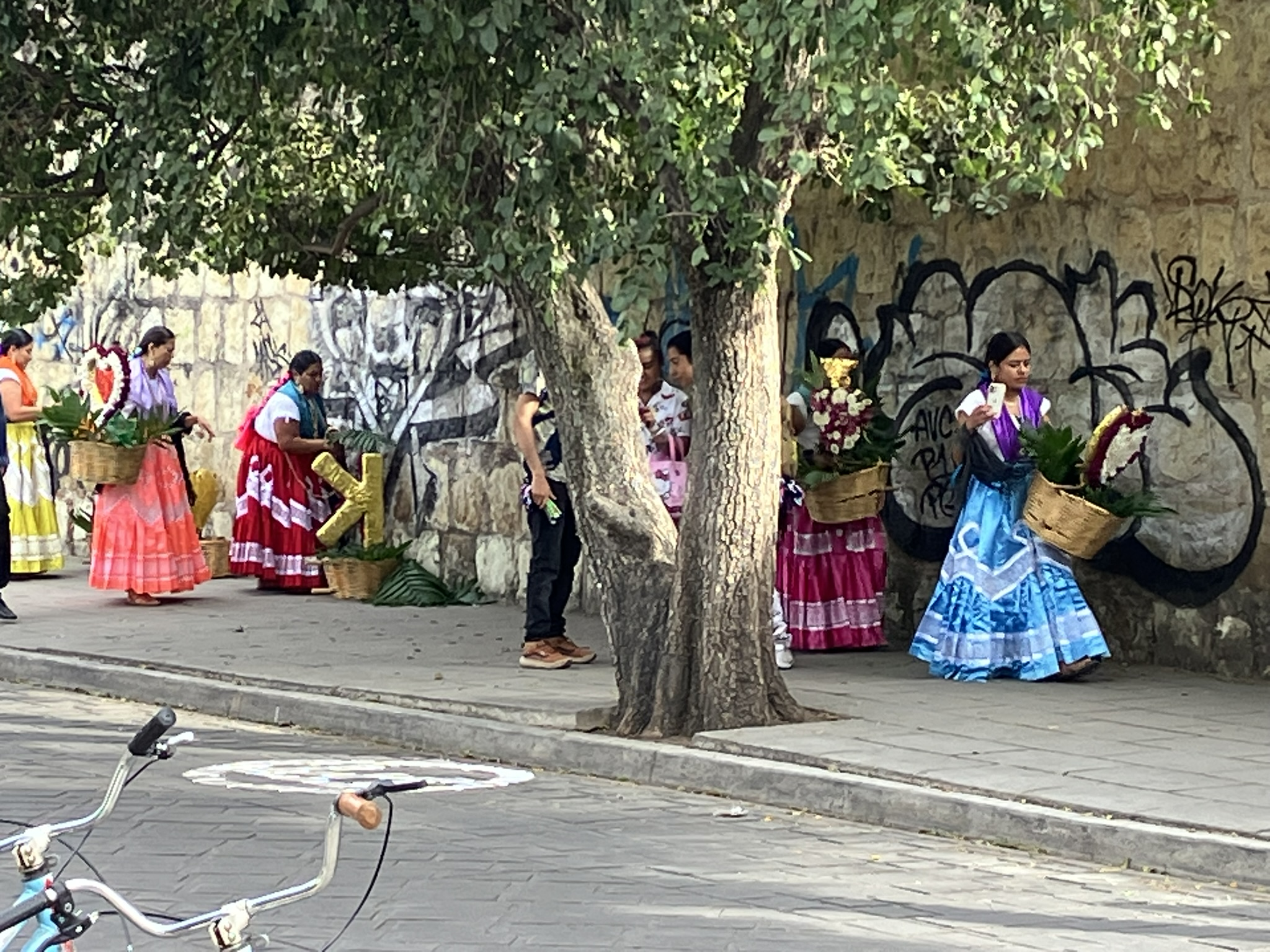
Indeed, multiple indigenous groups and cultures make up Oaxaca, and it’s easy to see the varied ethnic makeup of the city just by walking the streets, sometimes by physical appearance and other times by appearance and dress, in which it’s common to see men and women, but especially women, dressed in indigenous clothing.

P

It’s really very wonderful that Oaxaca has become a contemporary small city that has built upon and retained its multi ethnic and cultural heritage, which is clear throughout the city. Here’s a little bit about Oaxaca and its history.
Oaxaca is one of 31 states (32, if you count Mexico City, which is its own federal entity). The city is formally named Oaxaca de Juárez, named for Benito Juárez, who was a native of Oaxaca and the first indigenous (Zapotec) President of Mexico, serving from from 1858 until his death in office in 1872.
The city, which is the capital of the state of Oaxaca, has a population of about 720,000, and lies in the central valley of the surrounding Sierra Madre mountains.
Indigenous settlements have existed here for thousands of years, dating back to perhaps 11,000 BCE. The Aztecs entered the valley in 1440, or maybe earlier, followed by the Spanish colonization beginning in 1521, and the city became a municipality in 1821, after Mexico gained its independence. The city, and the entire region, remains a seat of indigenous culture, with 16 officially recognized indigenous cultures in the state, and most notably the Zapotec and Mixtec cultures. The state contains more speakers of indigenous languages than any other Mexican state. So there.
I was glad to get back to Rachel’s after walking back from the bus station, as by now my right shoulder, with a torn rotator cuff, was very sore and needed some rest. But after a couple of hours at Rachel’s, we headed back out to the Santa Domingo church, a center for weddings and the street parades that often follow, and I knew there was going to be a wedding today and wanted to see it.
On our way to the Templo de Santo Domingo de Guzmán (the church and convent of Santo Domingo de Guzmán), we passed a Quinceañera – a young woman turning 15 – in her Quinceañera dress, preparing for her ceremony.

We arrived at Santa Domingo church, with its construction completed in 1724, yet another beautiful building in the city, where the wedding party was gathering in preparation for the street party and procession.


This was clearly an American wedding, and I actually overheard people on my plane talking about attending a large wedding, which I suspect was this one (but who knows?), which had all the traditional frills. Most of the wedding guests wore white, but the ceremony was enlivened by a local band and indigenous dancers dressed in traditional attire, who surrounded the bride and groom (Kendra and Zack). These are the Isthmus women, from the matriarchal society of Tehuantepec, with their traditional and colorful Tehuana dresses adopted and made famous outside of the region by Frida Kahlo, who not only dressed in that style, but also depicted the attire in her art. The Isthmus of Tehuantepec remains the center of Zapotec culture.


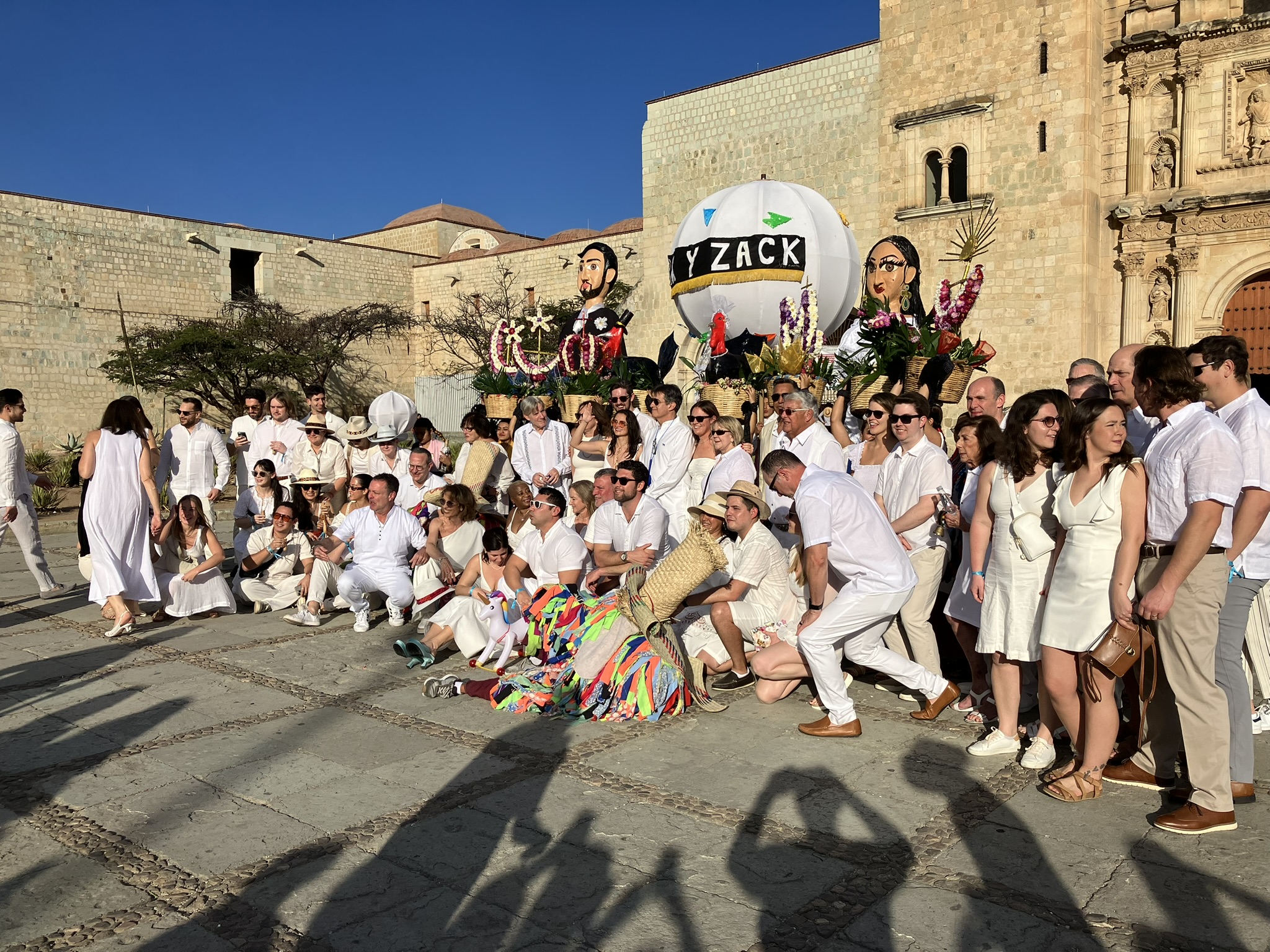

It wasn’t a particularly large wedding as I understand such weddings can be, but from my perspective was just the right size, and really fun and interesting to watch and photograph.
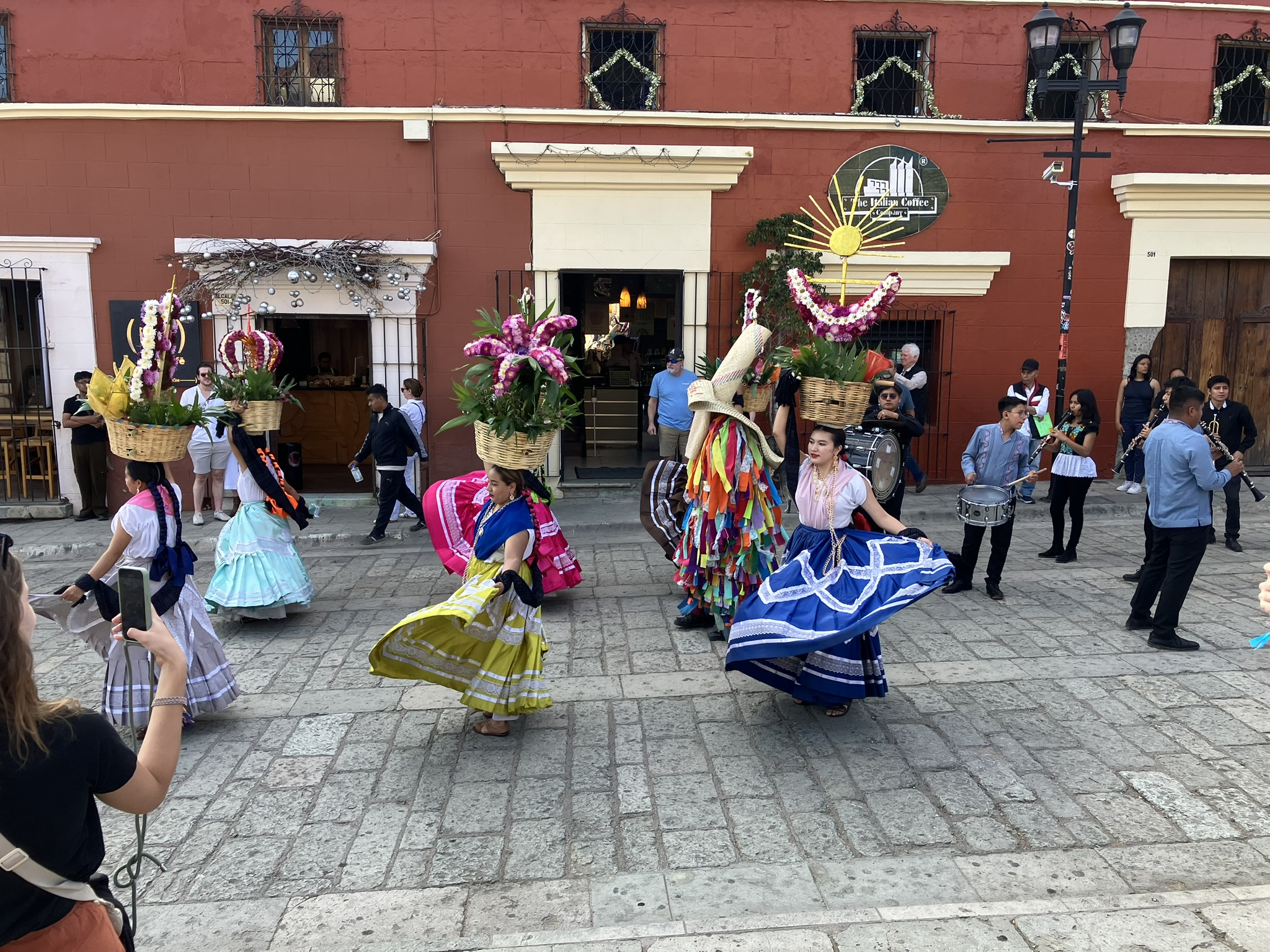
After the wedding party and band paraded away from the church, singing and dancing down the street, Rachel and I headed uphill to the Panoramica area of the city, which is named for its views of the city, and to Lila Downs’ restaurant, Humito Cocina (Smoke Kitchen), which we visited with the intention of having dinner there later. It was just a real kick being there, and I guess Lila lives close by, and sometimes performs at her restaurant, as well as featuring other local music. We wound up not going back there for dinner later, but I hope to next week. I noted that one of the items on the menu was Cumbria El Mole, the name of one of her songs that I really love, which is about how Mole is made in Oaxaca, which is famous for its Mole. Anyway, I do hope to get back there for dinner one day next week.


Rachel had an invitation to go dancing that night, which she loves to do, and so we headed back to the house, stopped in a small museum, which really had some wonderful traditional art, including sculpture and jewelry, stopped for a drink (I had a soda), and headed home.

Rachel made the tacos, which we had for dinner, we hung out for a bit, and then Rachel went off to dance around 9. I worked on my blog, and then it was time for dormir (sleep). Tomorrow, I catch the bus for Mazunte.
